
Part 1: Core Concepts (2 Marks)
- Computer System: An electronic, programmable device that accepts raw data as input, processes it systematically In standard academic theory (stored), instructions, produces meaningful information as output, and stores results for future retrieval.
- Von Neumann Architecture: The foundational theoretical framework of modern computing characterized by a single shared memory structure for both instructions and data, a central processing unit (ALU + Control Unit), and sequential instruction execution.
- DIKW Hierarchy: The progressive cognitive pipeline transforming unorganized symbols (Data) into contextualized structured facts (Information), actionable understanding (Knowledge), and ethically grounded judgment (Wisdom).
- Five Computer Generations: 1st (Vacuum Tubes, Machine Language), 2nd (Transistors, Assembly), 3rd (Integrated Circuits, High-Level Languages), 4th (VLSI Microprocessors, Personal Computers), and 5th (ULSI, Parallel Processing, Artificial Intelligence).
Part 2: Structural Frameworks (10 Marks)
Von Neumann Computer Architecture & Internal Subsystems
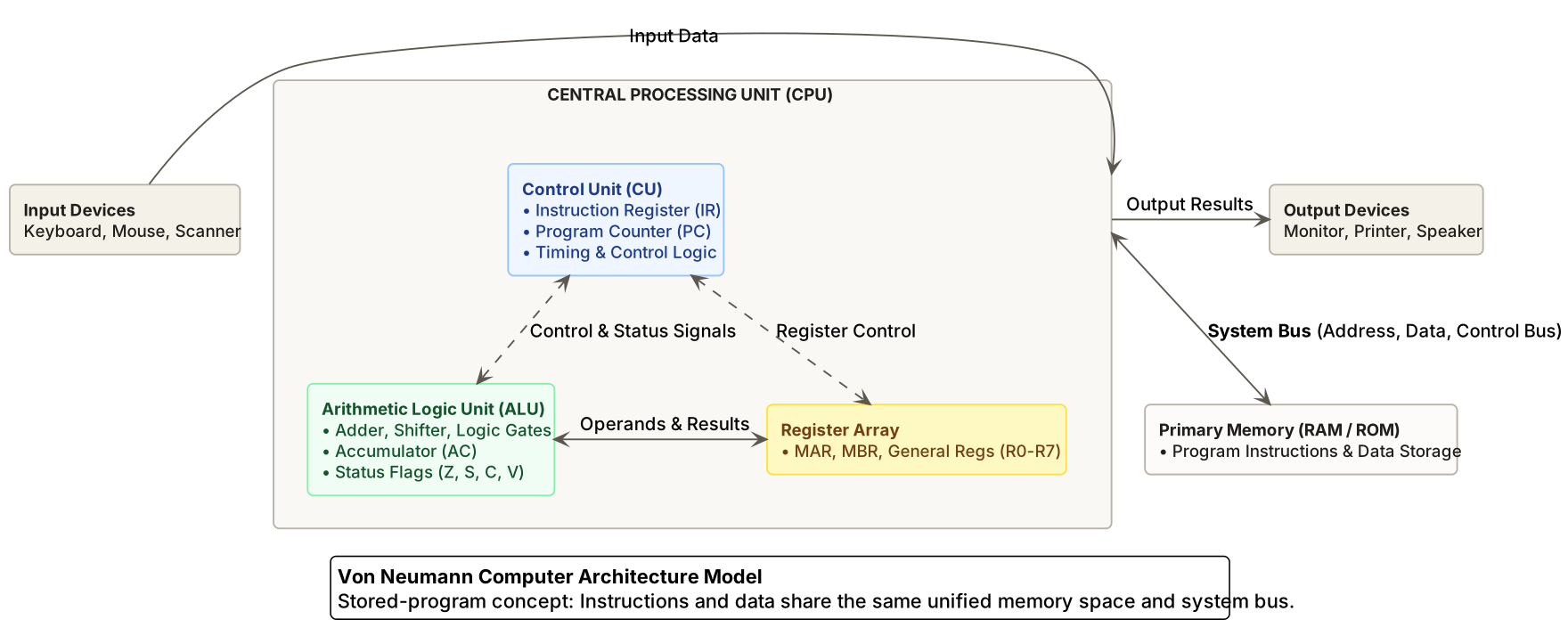
| Subsystem / Bus Component | Primary Architectural Role | Functional Mechanism & Registers Involved |
|---|---|---|
| Control Unit (CU) | Instruction sequencing & supervisory control | Fetches instructions into IR, decodes opcodes, coordinates timing via Program Counter (PC) |
| Arithmetic Logic Unit (ALU) | Arithmetic ( |
Executes computations using Accumulator (AC) and updates Status/Flag register ( |
| Register Array | High-speed temporary working memory inside CPU | Holds operands, memory pointers (MAR, MBR/MDR), and intermediate results |
| System Bus: Data Bus | Bidirectional operand transfer | Moves data between CPU registers and primary memory |
| System Bus: Address Bus | Unidirectional memory addressing | Specifies physical memory address for read/write operations (determines maximum RAM address space) |
| System Bus: Control Bus | Unidirectional/Bidirectional control synchronization | Transmits READ, WRITE, CLOCK, and INTERRUPT signals across components |
Part 3: Distinction Tables
| Basis of Comparison | Primary Memory (RAM) | Secondary Storage (SSD/HDD) |
|---|---|---|
| Nature of Volatility | Volatile (loses contents when power is disconnected) | Non-volatile (preserves state indefinitely without power) |
| CPU Accessibility | Directly addressable by CPU via address/data buses | Indirect access via I/O controllers and DMA channels |
| Access Latency | Nanoseconds ( |
Microseconds to milliseconds ( |
| Cost per Gigabyte | Substantially higher (\text{USD } 3-\text{USD } 5/GB) | Economical (\text{USD } 0.02-\text{USD } 0.08/GB) |
Part 4: Worked Problems & Exam Traps
Calculation of Bus Bandwidth
Example: A 64-bit data bus operating at a clock frequency of
TU Exam Trap: Do not confuse the Von Neumann architecture with the Harvard architecture. Von Neumann uses a single unified memory and bus for both instructions and data (causing the ‘Von Neumann Bottleneck’), whereas Harvard utilizes physically separate memories and buses for instructions and data.